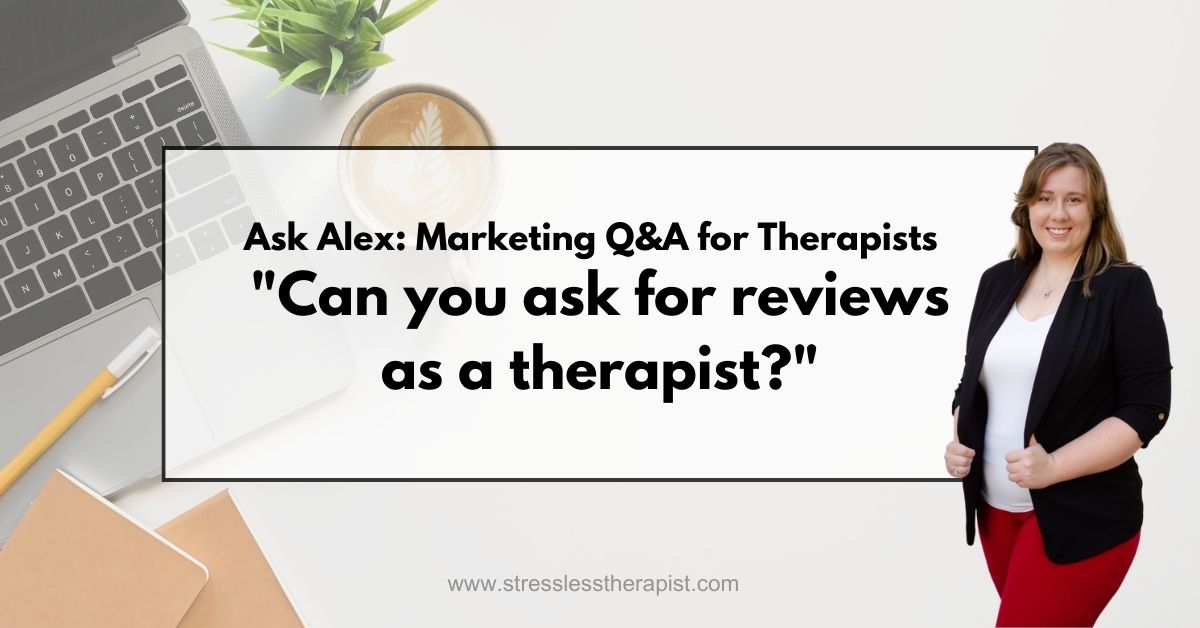
Ask Alex: Marketing Q&A for Therapists | Can you ask for reviews as a therapist?

Welcome to Ask Alex, where I answer your most pressing marketing questions as a marketing coach for therapists! Today’s question: Can you ask for reviews as a therapist?
Hi, I’m Alexandria—a former full-time therapist turned marketing coach. I’m dedicated to helping mental health & holistic professionals attract their ideal clients using ethical, authentic strategies like blogging, SEO, and email marketing. >>> Learn more about my services here.
In this Q&A series, I’m sharing practical, no-fluff advice to help you boost your online presence and grow a thriving private practice. If you have a question you would like to submit to this micro-blog series, please complete this form.
Let’s dive in!
About the Author
Alexandria believes that coaches and wellness providers deserve a marketing strategy that works as hard as they do—without the hustle. That’s why she is committed to helping them get found online through SEO-driven, conversion-focused copywriting. Because when your message is clear and your content is strategic, Google can bring the right clients to you—so you can focus on the work (and life) that matters most.

Hi, I’m Alexandria! Thank you for visiting my corner of the internet.
Can You Ask for Reviews as a Therapist?
If you’ve ever wondered, “Can you ask for reviews as a therapist?” you’re not alone. It’s a complicated area, mainly because each therapy license has its own ethical guidelines, and there’s no one-size-fits-all answer. However, let’s break down some key considerations to help you make an informed decision.
Why Asking for Reviews Can Be Tricky
As a licensed social worker, I tend to err on the side of caution and usually recommend against asking clients directly for testimonials. The primary concern? Protecting client confidentiality. Even if you use a first name, there’s always a risk someone could recognize the individual based on a brief description or context of their experience, especially if their family or friends come across the testimonial.
Moreover, Google reviews are particularly problematic because they usually display the reviewer’s name, which can inadvertently break HIPAA compliance. This makes it incredibly challenging to maintain the confidentiality and privacy of your clients.
Related Post: Ethical Marketing For Therapists — Top Tips For Reaching Clients While Staying True to Your Values
What To Do Instead
If you still want to gather testimonials or reviews, consider doing so indirectly. This means never explicitly asking a client for a testimonial, but rather providing them with easily accessible opportunities to leave one if they wish. Here are some ideas:
- Include a Review Link in Your Email Signature: Adding a subtle line in your email signature, such as “If you’d like to share your experience, click here,” can give clients a gentle nudge without feeling pressured.
- Use a Google Form for Feedback: If you choose to collect testimonials via a Google Form, make sure clients are clearly informed about how their feedback will be used. Consent forms should be part of this process to ensure ethical standards are maintained.
- Consult Your Licensing Board: Always double-check with your licensing board or ethical guidelines before implementing any testimonial-collection strategy. This ensures you’re staying compliant and protecting your clients’ privacy.
And most importantly, if a client ever asks for their testimonial to be removed, you must honor that request immediately, no questions asked.
Related Post: The Truth About Marketing for Therapists: 5 Myths Exposed
Testimonials Aren’t the Only Way to Build Credibility
While testimonials are powerful social proof, they’re not the only way to show potential clients that you’re capable of helping them. As a marketing coach, I help therapists use their copywriting — the words on their website, blogs, emails, and social media — to connect with their audience effectively. When done right, this approach allows you to demonstrate your expertise without ever referencing specific client stories.
Related Post: Can a Therapist Have a Blog? Here’s What You Need to Know
If you want to learn how to market your private practice while respecting ethical boundaries, feel free to check out my private coaching services. Let’s discuss how you can attract your ideal clients without compromising your professional integrity.

Ready to Attract Clients Who Truly Connect with You?
Want expert guidance to build your caseload faster and more effectively? That’s where my private coaching comes in.
During our six months together, we’ll lay down a solid foundation around identifying your ideal client and crafting messaging that truly resonates. From there, we’ll develop and optimize your blog and email marketing strategy—infusing your unique personality every step of the way. It’s like your own transformation montage, where you go from feeling lost to thriving, thanks to a clear roadmap and the right support.
Together, we’ll define your ideal client and create messaging that speaks directly to their needs. We’ll build a strategic content plan that boosts your blog’s visibility on Google, making it easier for clients to find you. Plus, we’ll implement automated email systems to nurture potential clients even when you’re off the clock—whether you’re working with clients or savoring a rare, peaceful moment while your toddler watches Bluey.
Why spend time struggling to be heard when you can collaborate with someone who’s walked this path before? Let’s make your marketing feel as satisfying as a 90s power ballad—memorable, authentic, and unmistakably you.
Looking for tailored strategies to fill your support groups more quickly and efficiently? Learn more about my coaching services and how I can help you build marketing systems that work.
🔗 Click the appropriate button below: