

The Do’s and Don’ts of Progress Notes
Progress notes are crucial components of clinical documentation utilized by social workers to talk with members of the medical treatment team and insurance companies about the client’s progress and setbacks. This documentation may also be reviewed by the patient or their family, so the notes should be detailed enough to allow reviewers to understand the situation but not so private as to eliminate the confidentiality that protects it. It can be overwhelming at times to determine what should and should not be included in a note, as there is so much that goes on in one 45 minute session. Below will go over the basics of note writing as well as recommendations as to what to include as well as what to avoid when documenting client sessions.
About the Author
In addition to being a therapist, I’m a marketing coach for mental health professionals. I help therapists like you not only streamline their clinical documentation but also build a thriving private practice. If you’re looking for support in scaling your practice while keeping your documentation in check, learn more about my coaching services by clicking the button below.

Hi, I’m Alexandria! Thank you for visiting my corner of the internet.

What to include in a progress note
In any given mental health progress note, there are certain elements that should be included in order to provide an accurate and complete picture of the client’s current status. First and foremost, the date and time of the session should be noted. This is followed by a brief description of the client’s presenting problem or reason for seeking services. This includes describing the nature of the problem, how long the client has been experiencing it, and any relevant background information. Additionally, it is important to document what progress the client has made since beginning treatment. This can include any positive changes in symptoms or functioning, as well as any setbacks or plateaus. If a setback of plateau occurs, it is usually best practice to identify why this is happening (if the reason is known).
The next section should include a summary of the therapist-client interaction during the session. This can include anything from how the client was feeling during the session to what topics were discussed. Be sure to note how the client responded to the interventions. Finally, the progress note should end with a brief conclusion or summary of the session as well as any goals or plans for future sessions.
Knowing what to include in your progress notes can save you time and keep you compliant. But what if you could also streamline your documentation process while scaling your private practice? My marketing coaching can help you not only refine your clinical notes but also optimize your workflow so you have more time to grow your business.
>>> Discover how coaching can help you manage your time more effectively here.
What not to include in a progress note
A mental health progress note is a tool used by clinicians to document and communicate a client’s progress in therapy. While there is no one “right” way to write a progress note, there are some things that should be avoided. Here are three things to avoid when writing mental health progress notes:
1. Avoid using heavy amounts of clinical jargon: Jargon can be confusing and off-putting for clients. Instead, use clear and concise language that can be easily understood by the client. If you are going to use a clinical term, be sure that you are using it correctly and a way that can be understood with relative ease by a non-clinical person as they read through the note. Often times insurance reviewers do not have a clinical mental health degree, therefore if too much jargon is used and the note it not understandable, there is a higher risk for an insurance denial or audit.
2. Avoid making assumptions about the client: Every client is unique and should be treated as such. Progress notes should reflect this by avoiding generalizations and stereotypes. Stick to the facts only. Any personal assumptions or theories should be kept in a psychotherapy note and not within the medical documentation of a progress note.
3. Avoid sounding judgmental: It is important to remain objective when documenting a client’s progress. Judgmental language can be interpreted as bias and undermine the relationship between clinician and client.

Leaving out irrelevant information in your progress notes ensures clarity and compliance. But what about the rest of your business? If you’re looking to streamline your entire practice—from documentation to marketing strategies—my coaching services can help.
>>> Find out how my coaching can help you run an efficient and profitable practice here.
How to format a progress note
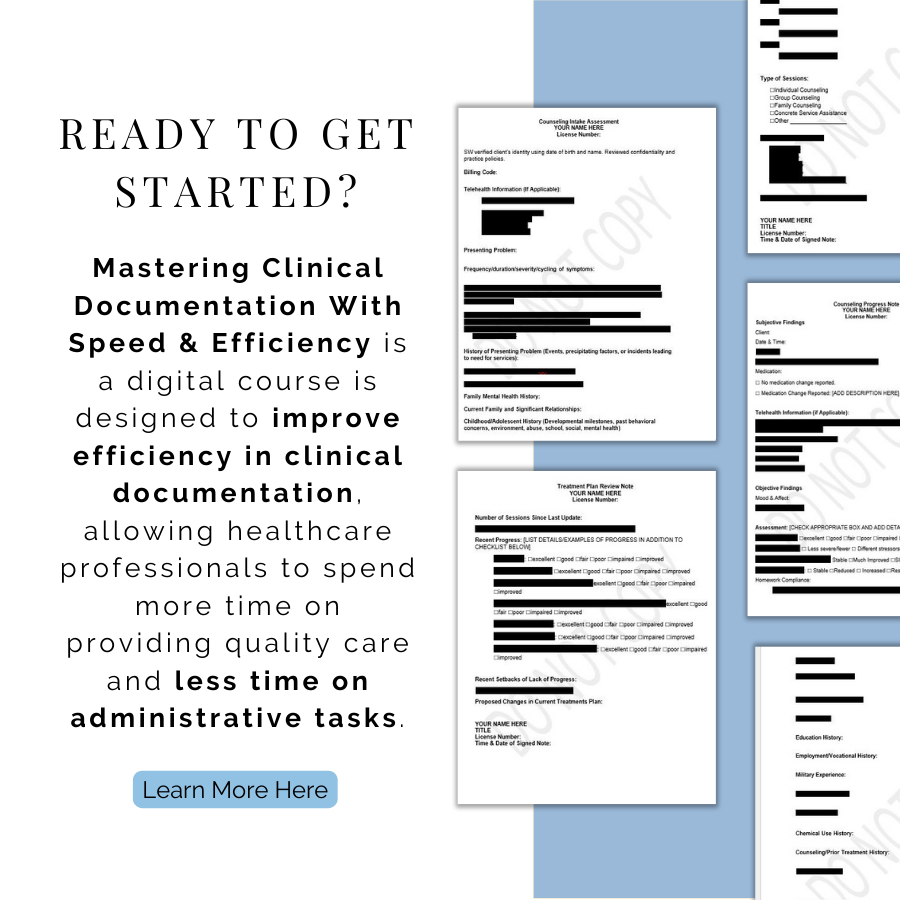
I personally enjoy using a SOAP note format for my progress notes. To read more about how to write a great SOAP note read my latest post here. My masterclass: Mastering Clinical Documentation With Speed and Efficiency breaks it down my exact format in template form so you no longer have to do any guess work as to what to include in order to get reimbursed for your hard work. Access it here to get started!
Formatting your progress notes correctly not only keeps you organized but also saves you time. My coaching services focus on helping therapists like you streamline tasks like documentation so you can spend more time on the parts of your business that grow your income and client base.
>>> Explore how I can help you achieve this through my marketing coaching here.
The benefits of using progress notes
In my clinical practice, I have found that using mental health progress notes is an extremely beneficial way to document treatment. Not only does it provide a detailed record of what has been discussed and accomplished during each session, but it can also be used to help track a client’s progress over time.
I often find myself referring back to old progress notes when meeting with a client for follow-up appointments. It’s helpful to be able to see how far they’ve come and what issues they may still be struggling with. Additionally, progress notes can be useful in identifying any patterns or trends in a client’s behavior or symptoms.
Overall, I believe that mental health progress notes are an invaluable tool for social workers and other mental health professionals. They provide us with a way to accurately document our work with clients and track their progress over time.
The benefits of using progress notes go beyond just staying compliant—they help you run a more organized and efficient practice. Imagine if that same efficiency applied to the rest of your business. My coaching program helps therapists not only with their clinical work but also with building a sustainable, profitable practice.
>>> Learn more about how coaching can help you enhance both your clinical work and business growth here.
The importance of accuracy in progress notes
As a social worker, progress notes are an important way to document interactions with clients and track their progress. Accuracy is essential in order to provide the best possible care for clients and to ensure continuity of care if another social worker takes over their case.
Progress notes can be used in a variety of ways, including to assess whether goals are being met, to document changes in a client’s condition, or to provide justification for continued services. Inaccurate progress notes can lead to false assumptions about a client’s progress and may even result in them not receiving the services they need.
If a client’s sessions are reimbursed by insurance and there is inaccurate data, the insurance reserves the right to deny payment and may even file the claim as insurance fraud. Even if the intentions are good and an honest mistake was made, accuracy errors can leave a practitioner open to legal recourse and malpractice.
It is therefore essential that social workers take the time to write accurate and detailed progress notes. This may require some extra time initially, but it will pay off in the long run by providing better care for clients and avoiding any potential problems that could arise from inaccurate documentation.
Accuracy in progress notes is critical for maintaining professionalism and client trust, which are essential to any therapist’s success. Similarly, your marketing strategy must also reflect trust and professionalism to attract the right clients. In my coaching, I work with therapists to ensure their practice runs smoothly both clinically and from a business perspective.
>>> See how coaching can help you build a practice that thrives on trust and accuracy.
Summary
In conclusion, writing a mental health progress note is important for treatment as it helps to document changes in a client’s condition. It is important to be accurate and objective when writing progress notes, as this information can be used to make decisions about a client’s treatment.
Want an easy way to write your clinical documentation?
My masterclass: Mastering Clinical Documentation With Speed and Efficiency breaks it down in template form so you no longer have to do any guess work as to what to include in order to get reimbursed for your hard work. Access it here to get started!
NEXT STEPS…
Now that you’ve learned the do’s and don’ts of progress notes, are you ready to take your entire practice to the next level? My marketing coaching services help therapists not only master clinical documentation but also build sustainable, thriving practices.
[mailerlite_form form_id=3]


