

Therapists Struggle with Imposter Syndrome: Are You Holding Back Your Inner Entrepreneur?

Affiliate Disclosure
Some of the links on this website are affiliate links, which means that I may earn a commission if you click on the link or make a purchase using the link. When you make a purchase, the price you pay will be the same whether you use the affiliate link or go directly to the vendor’s website using a non-affiliate link.
For your convenience we have listed our affiliate partners here: Amazon, Headway, Alma, Kate Doster, Elizabeth Goddard, Tonic Site Shop, Branden Drake, Canva, Mailerlite, ConvertKit, WordHero AI, ThriveCart, Airtable, System io, SimplePractice.
Though the products may not created by us, our opinions of the products are entirely our own. We only recommend products that we love and stand behind in hopes they help you as much as they helped us. By using the affiliate links, you are helping support this website, and I genuinely appreciate your support as it helps me to continue to create content such as this.
I worry that I am not as good at my job as I think I am.
People tell me I do good work: my supervisor, peers, clients…but there is a nagging voice in my head that says, “you can do better.”
That same irritating voice always has something to say…
“You aren’t helping anyone.”
“It is your job to fix them, and they are still struggling. Clearly you are doing something wrong.”
“Others get results faster; you must be doing something wrong”
I feel defeated by this voice. Feeling stupid. Feeling never enough.
Intellectually knowing this self-doubt can’t be 100% true. You attended a top college and received great marks. Job interviews go amazingly well (if anything you are often poached from other places), but yet despite all the evidence to the contrary, the voice in the back of the mind continues to wispier “failure.”
It’s a cruel paradox: the more validation you receive, the louder the whispers of inadequacy become.
Obsessed with learning more to benefit your clients and enhance your skillset. Books, articles, worksheets, anything you can get your hands on and absorbed with desperation for improvement. Despite all the education however, confidence still waffles, afraid to test the new theories because of the whispers:
“What if I screw up more?”
“One course does not make you qualified to practice the technique.”
“Your clients deserve better.”
Day, night, it doesn’t matter. The voice continues and has been unwavering for years.
At the end of the day, you feel like an imposter.
You find yourself trapped in a tug-of-war between external validation and internal criticism. On one hand, there’s the evidence of your accomplishments: stellar academic achievements, glowing performance reviews, and a trail of successful job interviews. Yet, juxtaposed against these accolades is the relentless scrutiny of your own mind, constantly second-guessing your abilities and magnifying every perceived shortcoming.
Who to listen to: the people singing praises or the voice in my head?

Sound Familiar?
As a mental health professional, you’ve likely spent years honing your skills, supporting others through their struggles, and advocating for their well-being. Yet, as you contemplate stepping into the realm of entrepreneurship and launching your own private practice, a familiar adversary may emerge: imposter syndrome. This insidious phenomenon can cast a shadow over your aspirations, whispering doubts about your capabilities and worthiness to succeed in the competitive landscape of private practice.
Leaving the confines of a community mental health clinic, where structure and support often cushion the blows of self-doubt, can feel like stepping into the unknown abyss. The transition from clinician to business owner requires not only clinical expertise but also a whole new skill set encompassing marketing, finances, and practice management. It’s no wonder imposter syndrome rears its head, questioning whether you have what it takes to thrive in this unfamiliar territory.
What is Imposter Syndrome?
Imposter syndrome is widespread for many working Americans, especially those men and women in high earning professions. Nearly 80% of people struggle with feelings of being an imposer at some point in their lives; triggering feelings of inadequacy and self-doubt that they have not earned what they’ve achieved (Bravata, D. M., et al., Journal of General Internal Medicine, Vol. 35, No. 4, 2020). Left unchecked, imposter syndrome can exacerbate or even cause symptoms such as depression, anxiety, and burnout.
For those who may be unsure of what to look for, imposter syndrome left untreated can cause or exacerbate the following:
| Depression | Anxiety | Burnout | |
| Physical Symptoms | Weight loss/gain Increased/decreased sleep Fatigue Nightmares Body pains Headaches Frequent sickness | Shaky Restlessness Upset stomach Appetite changes Sleep changes Nightmares Racing thoughts Exhaustion | Fatigue Frequent illness Headaches Body pains Change in appetite Changed sleep habits |
| Emotional Symptoms | Sadness Anger Hopelessness Helplessness Low motivation | Nervousness Irritability Feeling constantly on edge Fearful | Self-critical Hopelessness Helplessness Feeling trapped/defeated Low motivation Pessimistic Apathetic Low feelings of accomplishment Feeling like a failure |
| Behavioral Symptoms | Social isolation Crying Self-criticism Loss of interest in hobbies/activities Avoidance | Pacing Avoidance Isolating from others | Withdrawing from responsibilities Stress eating Irritable Procrastination Isolation Frequently leaving work early or coming to work late |
Interested in this topic and want to learn more? Pick up and read (Amazon affiliate link): Why Do I Feel Like an Imposter?: How to Understand and Cope with Imposter Syndrome by Dr. Sandi Mann
How are Imposter Syndrome And Perfectionism Linked?
Perfectionism and imposter syndrome often go hand in hand, creating a detrimental cycle of self-doubt and anxiety. Perfectionists set unrealistically high standards for themselves, leading to constant feelings of inadequacy when they inevitably fall short. This fear of not being good enough fuels imposter syndrome, as individuals believe they are undeserving of their accomplishments due to perceived flaws or mistakes.
Moreover, the relentless pursuit of perfection can prevent individuals from taking risks or trying new things for fear of failure. This fear further reinforces imposter syndrome, as those affected feel like frauds who will eventually be exposed. The link between these two phenomena highlights the importance of addressing underlying beliefs about self-worth and redefining success beyond flawless performance. Embracing imperfection and recognizing that making mistakes is a natural part of growth can help break the cycle and alleviate feelings of impostor syndrome in perfectionists.

Imposter Syndrome Impact On Your Business
Imposter syndrome, a common psychological phenomenon, can be a significant barrier for therapists looking to transition into business owners. Despite their expertise and qualifications, therapists may struggle with feelings of inadequacy and self-doubt when faced with the challenges of running a business. This internal struggle often leads to hesitation in taking the necessary steps towards entrepreneurship.
The fear of being exposed as a fraud or not measuring up to societal expectations can prevent therapists from embracing their entrepreneurial spirit fully. As healers and caregivers, they may find it difficult to shift their mindset from focusing on others’ well-being to prioritizing their own success. Overcoming imposter syndrome requires therapists-turned-entrepreneurs to recognize and challenge these negative thoughts, build confidence in their skills and abilities, and seek support from peers or mentors who can provide encouragement and guidance along the way.
Ultimately, acknowledging imposter syndrome as a natural part of the entrepreneurial journey can empower therapists to step out of their comfort zones, confront their fears head-on, and realize their full potential as successful business owners in the mental health industry. By reframing imposter feelings as temporary obstacles rather than permanent limitations, therapists can harness their unique strengths and experiences to create thriving businesses that not only benefit themselves but also make a positive impact on their clients’ lives.
Imposter Syndrome Unchecked
Unchecked imposter syndrome can wreak havoc on your business plans in several ways:
- Self-Sabotage: Imposter syndrome can lead to a lack of confidence in your abilities, causing you to second-guess your decisions and hesitate to take necessary risks. This hesitancy can result in missed opportunities for growth and development within your business.
- Stagnation: When consumed by feelings of inadequacy, you may become paralyzed by the fear of failure. This can lead to a reluctance to innovate or expand your services, ultimately stifling the potential for your business to thrive and evolve.
- Undermined Client Relationships: Doubting your skills and expertise can undermine the trust and confidence that clients place in you. If you’re constantly questioning your own abilities, it can erode the trust that clients have in your capacity to help them, potentially leading to a loss of clientele and a damaged reputation.
- Limited Networking and Collaboration: Imposter syndrome may cause you to shy away from networking opportunities or collaborations with other professionals in your field. This can limit your exposure to new ideas, resources, and potential partnerships that could benefit your business in the long run.
- Burnout: The relentless pressure to prove yourself and the constant fear of being exposed as a fraud can take a toll on your mental and emotional well-being. Left unchecked, imposter syndrome can contribute to burnout, leaving you feeling exhausted, overwhelmed, and disillusioned with your business endeavors.
Overall, imposter syndrome can act as a significant barrier to the success and growth of your business if left unaddressed. It’s essential to recognize the signs of imposter syndrome early on and take proactive steps to challenge and overcome these negative self-perceptions. Seeking support from mentors, coaches, or mental health professionals can provide invaluable guidance and encouragement as you navigate the challenges of entrepreneurship. Remember, you are capable, deserving, and worthy of success in your business endeavors.

What can be done about it?
I dream of a day where I can walk out of a session feeling confident in myself, knowing that I gave it my best effort and to not struggle with the “what if’s” for hours afterwards.
To be able to go home at night and leave work at the office, instead spending time focusing on my family. To participate in hobbies guilt free. No more Sunday Scaries worried about what Monday’s caseload will bring.
Wouldn’t it be nice to be able to ACCURATLY look at an honest day’s work and see not just where you need to improve but also what you did well?
Below are my top three tips on how to challenge imposter syndrome:
- Cognitive Assessment and Reframing (reactive strategy)—look at each thought individually and asses the truth behind each statement. Once that is done, take time to brainstorm any counter evidence for the thought. Use the chart/example below for assistance:
| Imposter Thought | Facts | Evidence that supports fact |
| Example: “I am a fraud” | I am intelligent and worked hard to get where I am today. | I attended a top school earning a degree in my field, with honors. I passed a board certification exam proving my competence. I obtain continuing education credits yearly to make sure that I am up to date on my education. |
- Strengths Identification (proactive and reactive strategy)—list your personal attributes (both professional and personal) to remind yourself of the good things you do. Bonus points if you can then use these identified strengths to counter any imposter thoughts. Examples of personal strengths can include but are not limited to:
- Good team player
- Values education
- Strong work ethic
- Non-judgmental
- Grateful
- Humorous
- Affirmations (proactive strategy)—affirmations are a great way to build a strengths-based mindset. Affirmations are often short present focused statements that you can say to yourself (out loud or in your head) that reflect a helpful action/mindset. Examples of affirmations to counter imposter syndrome are:
- “I do my best at every project I do.”
- “I am a hard worker who is an asset to any team”
- “I am an intelligent individual”
- “I am a strong and capable person”
- “My opinions are valued”
Note: If imposter syndrome starts impacting your mental health in areas such as depression and anxiety, be sure to reach out to your local mental health professional to help you work through it before it becomes overwhelming.
Next Steps…
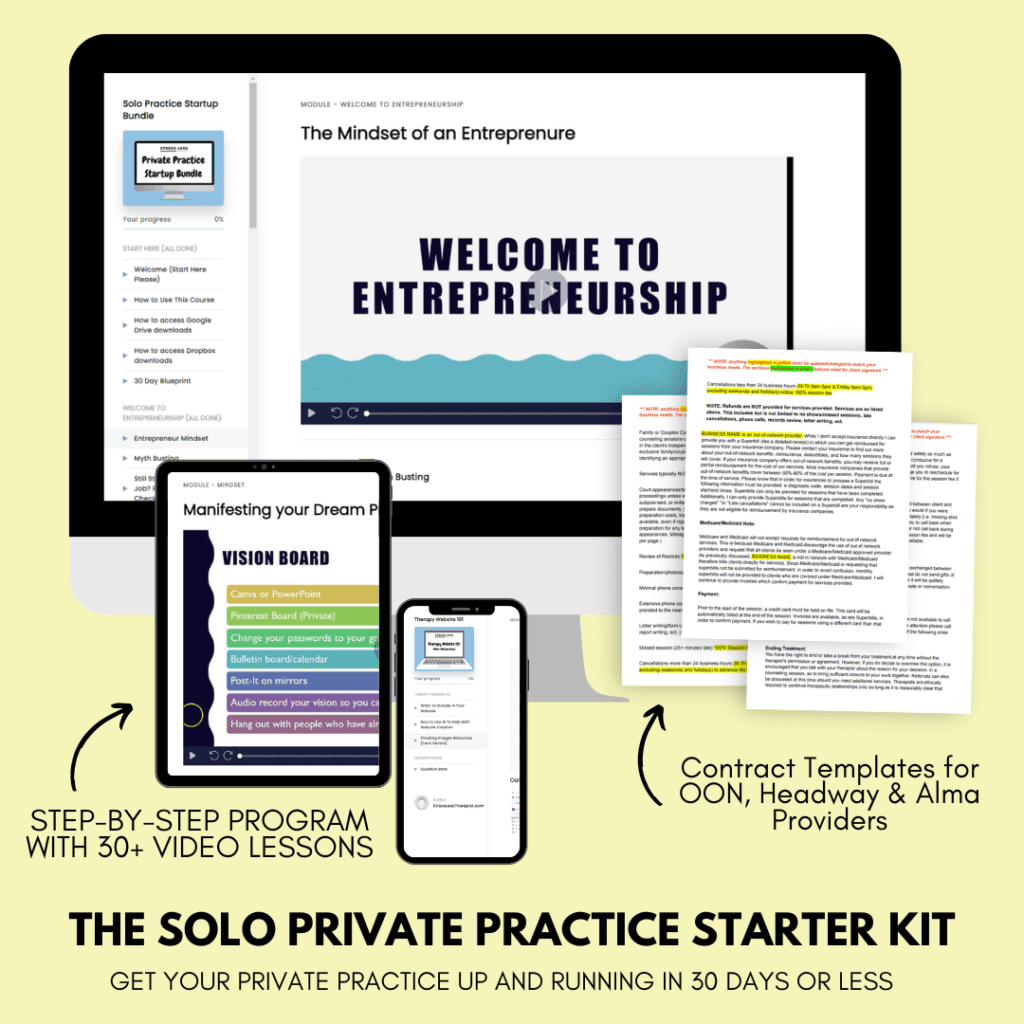
Are you a mental health therapist embarking on the journey of launching your private practice? Do you find yourself wrestling with imposter syndrome, doubting your abilities to thrive as a business owner? It’s time to break free from the grip of self-doubt and step into your full potential. My Solo Private Practice Starter Kit course is designed precisely for therapists like you, offering comprehensive guidance to address your questions and concerns as you embark on this exciting journey.
Through this course, you’ll gain the tools and knowledge you need to confidently navigate the complexities of starting your own practice. From building a strong mindset for entrepreneurship to mastering the intricacies of booking your first client, each module is crafted to empower you with practical strategies and insights. Together, we’ll tackle your doubts head-on, unlocking the confidence and clarity needed to build a successful private practice.
Don’t let imposter syndrome hold you back any longer. Sign up for the Solo Private Practice Starter Kit course today and embark on the path to owning your business with assurance and authenticity. Your dream practice awaits, and I’m here to guide you every step of the way.
Reference:
Bravata, D. M., Watts, S. A., Keefer, A. L., Madhusudhan, D. K., Taylor, K. T., Clark, D. M., Nelson, R. S., Cokley, K. O., & Hagg, H. K. (2020, April). Prevalence, predictors, and treatment of Impostor Syndrome: A systematic review. Journal of general internal medicine. Retrieved October 2, 2021, from https://www.ncbi.nlm.nih.gov/pmc/articles/PMC7174434/.